
If you are building a new home off the mains or your old tank has finally given up the ghost, you have a choice to make Plastic (Poly) or Concrete.
In Australia, both are solid options, but they are not interchangeable. Depending on your soil type, site access, and budget, one will usually be a clear winner.
I have been pumping out and inspecting both for years. Here is the straight-talking breakdown of how they compare when they are sitting in the ground.
1. Concrete Septic Tanks: The Old Reliable
Concrete tanks have been the standard in Australia for decades. If you want something you can set and forget for 30 plus years, this is usually it.
The Pros:
- Heavyweight Champion: They do not float. In areas with a high-water table, a concrete tank stays put because of its massive weight.
- Durability: They handle ground pressure and shifting soil better than plastic. You can usually bury them deeper without worrying about the walls caving in.
- Rust-Proof: Unlike old steel tanks, concrete will not rust out.
The Cons:
- Install Headache: A 3,000L concrete tank weighs several tonnes. You will need a crane or a serious excavator to drop it in. If your backyard has tight access, concrete might be off the table.
- Corrosion: Over 20 to 25 years, the gases inside the tank (hydrogen sulphide) can eat away at the concrete above the waterline, eventually making the lid or baffles crumbly.
Typical Cost: $2,500 $4,500 for the tank alone (plus $1,500 for heavy lift delivery and install).
2. Plastic (Poly) Septic Tanks: The Modern Alternative
Modern poly tanks are made from high density polyethylene. They have come a long way from the flimsy versions of the 90s.
The Pros:
- Easy Access: You can move a plastic tank with a couple of blokes and a small ute or a light tractor. If I am working on a property with narrow gates or lots of trees, plastic is the way to go.
- Chemical Resistance: Plastic is not affected by the gases that eventually rot concrete. The tank walls will not degrade over time.
- One-Piece Construction: Most are moulded as a single piece, meaning there are no joins to leak.
The Cons:
- The Float Risk: If the tank is empty (like right after a pump out) and you get a massive dump of rain, the groundwater can push a plastic tank right out of the ground like a cork.
- Installation Sensitivity: If the installer does not backfill correctly (usually with 7mm to 10mm gravel), the weight of the dirt can crush or deform the sides.
Typical Cost: $2,000 $3,500 (Delivery is much cheaper because no crane is required).
Side-by-Side Comparison
| Feature | Concrete Tanks | Plastic (Poly) Tanks |
|---|---|---|
| Weight | Very Heavy (3-5 tonnes) | Light (150-300kg) |
| Expected Lifespan | 30+ Years | 20-30 Years |
| Ease of Install | Difficult (Requires Crane) | Easy (Handled by 2-3 people) |
| Best For | High water tables / Cattle paddocks | Tight access / High-acid soils |
| Main Weakness | Gas corrosion over time | Risk of floating or crushing |
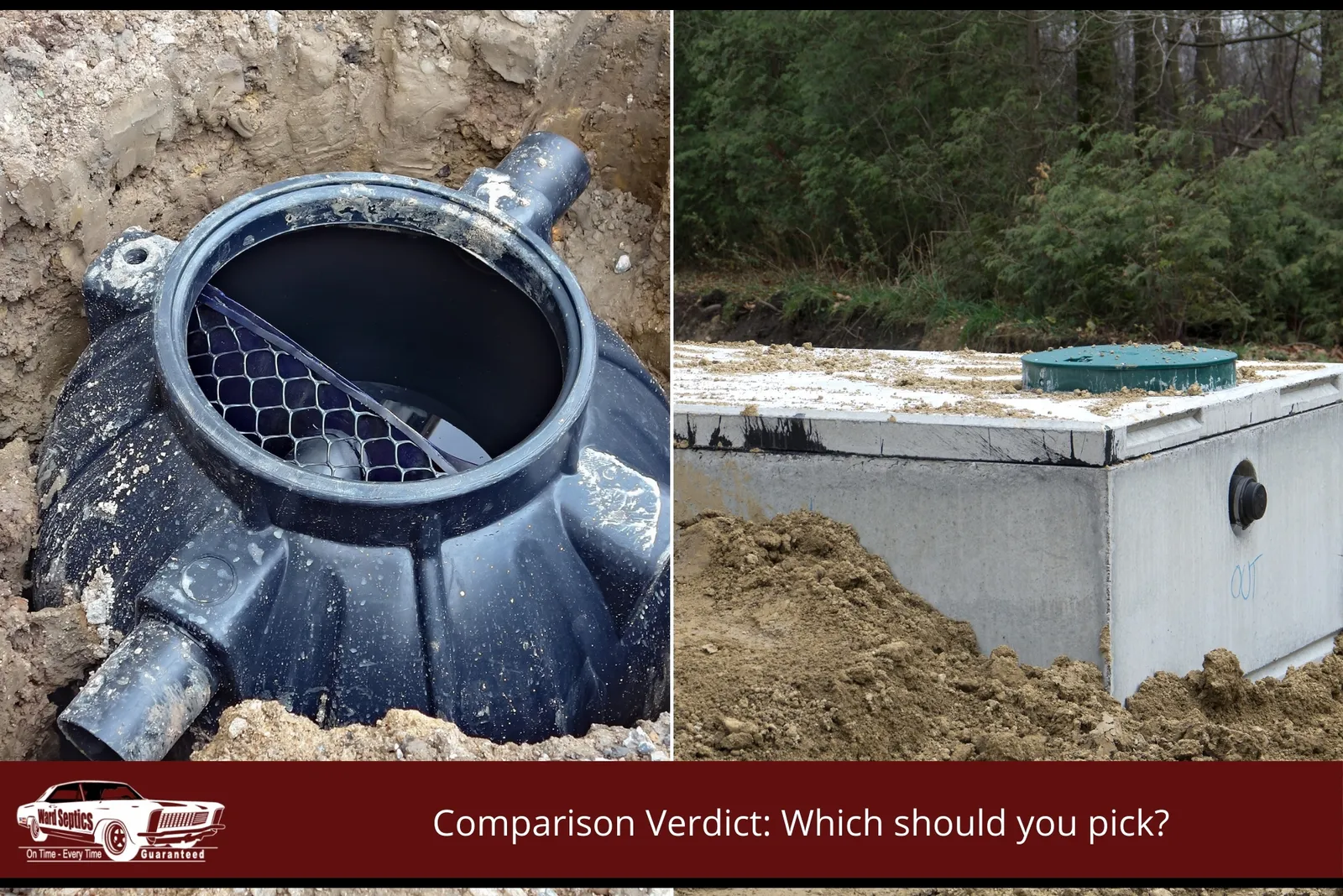
Comparison Verdict: Which should you pick?
Choose Concrete if you have wide open access for a crane truck, you are in an area with heavy, wet clay, or you plan on driving a ride on mower (or even a small tractor) over the area. It is a buy once, cry once solution.
Choose Plastic if you are on a steep block, have a narrow driveway, or are doing a DIY heavy install where you cannot get big machinery in. Just make sure your plumber installs an anti-floatation flange or anchors it if you are in a wet area.
A Quick Tip on Maintenance
Regardless of which tank you buy, the pump out schedule is the same. Most councils in Australia require a pump out every 3 to 5 years to keep the sludge from clogging your transpiration trenches. This is just one of the many septic services we provide to keep your system running safely.
Does your tank need a look? If you are smelling rotten eggs near the tank or your toilets are gurgling, do not wait until the yard is flooded with effluent.
You can contact us today for a quote on a pump out or a tank inspection in your local region.