Yes, tree roots can damage a septic system, and they do it quietly. By the time you notice soggy ground or a bad smell near your absorption area, the roots have often been working their way through pipe joints for years. On rural and semi-rural properties across the Central Coast and Hunter Valley, where established trees grow close to older septic systems, root intrusion is one of the more common reasons a system fails before its time.
Here's how it happens, which trees are the worst offenders, and what you can do to prevent it.
How tree roots find their way into a septic system
Roots don't seek out pipes deliberately, but they are drawn to moisture, warmth, and nutrients. A septic system, particularly the absorption trench area, provides all three. Even a well-installed system releases small amounts of vapour through pipe joints and the surrounding soil. That vapour is enough to attract root tips from trees many metres away.
Once a fine root tip reaches a pipe joint or a small crack, it can push through. Inside the pipe it finds exactly what it needs to grow, and it does. What starts as a hairline intrusion becomes a root mass over a season or two. That mass catches passing solids, narrows the pipe's flow capacity, and eventually blocks it.
The absorption trench is the most vulnerable part of the system. The perforated pipes in a trench are designed to let effluent seep out into the surrounding soil. Those perforations are also an easy entry point for roots. Once roots are established in a trench, they can collapse the pipe entirely, or create enough blockage that effluent backs up to the surface.
The tank itself is less commonly affected, but not immune. Concrete tanks develop hairline cracks over time. Roots can work into those cracks and, over many years, cause structural damage. A cracked tank is a more serious and more expensive problem to fix than a blocked trench pipe.
**Here's the key point:**roots don't break into a system all at once. The damage builds slowly and invisibly over years. By the time you see symptoms on the surface, the root mass inside is usually well established.
Which trees cause the most problems
Not all trees are equal when it comes to root aggression. The ones that cause the most septic damage are species with wide-spreading, water-seeking root systems.
Willows are the most aggressive. If you have a willow anywhere on your property, its roots will travel a long way toward any available moisture source. Poplars are similarly problematic. Both are common on older rural properties in the Hunter Valley and Central Coast hinterland.
Figs, including the commonly planted Port Jackson fig, have dense, surface-running root systems that can reach 30 metres or more from the trunk. Camphor laurels, which are widespread across the Central Coast, have the same characteristic. Eucalypts vary significantly by species, but the larger varieties develop aggressive lateral root systems that extend well beyond the canopy.
Bamboo is often underestimated. A clump of bamboo seems contained above ground. Below ground, the rhizome network spreads continuously and can penetrate pipe joints with surprising force.
Smaller ornamental trees and shrubs are generally lower risk but not zero risk, particularly if they're planted directly over or beside a trench. Grevilleas, bottlebrush, and hakea can all cause issues when planted too close.
**Here's the key point:**willows, poplars, figs, camphor laurels, and large eucalypts are the highest-risk species. If any of these are growing within 10 metres of your septic system, they warrant monitoring.
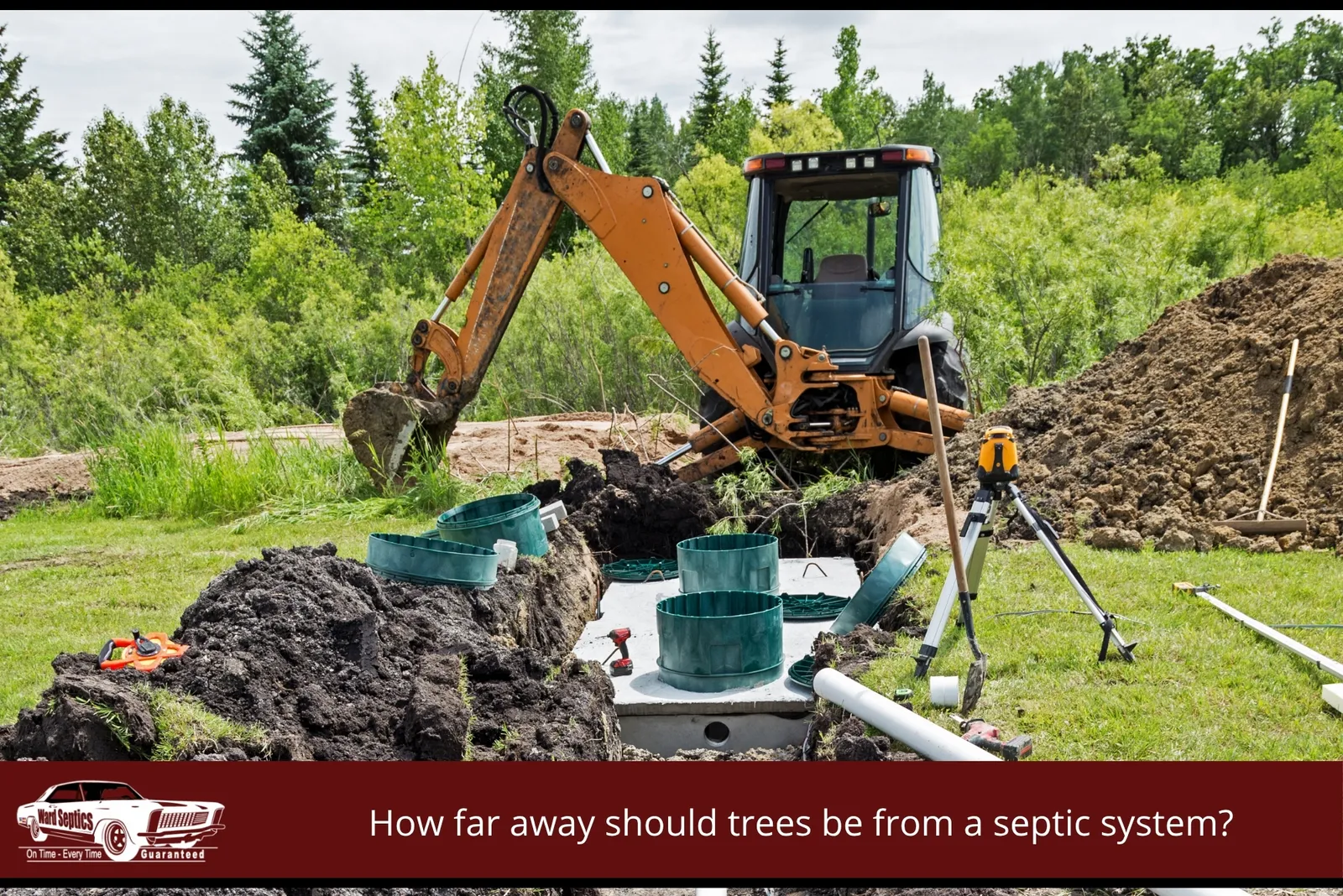
How far away should trees be from a septic system?
The general guidance from NSW plumbing standards is that trees should be planted no closer to a septic system than the mature height of the tree. A tree that grows to 10 metres tall should be at least 10 metres from any part of the system. For high-risk species like willows and figs, that distance should be greater.
The absorption trench needs the most clearance. As a practical rule on the Central Coast and Hunter properties we service, we recommend a minimum of 5 metres from any trench for low-risk small shrubs, 10 metres for medium-sized trees, and 15 metres or more for high-risk species or large trees.
Existing trees that are already close to a system are a harder conversation. Removing a large established tree is disruptive and sometimes not feasible. In those situations, monitoring the system more frequently and having the trench inspected if you notice any change in how the system is performing is the practical approach.
**Here's the key point:**distance matters more than species in practice. A low-risk tree planted directly over a trench is more dangerous than a high-risk tree 20 metres away. Clearance is the primary protection.
What to do if roots are already in the system
If you're seeing wet ground above the absorption area, a slow flush, or a sewage smell near the trench, root intrusion is one of the first things to check. The diagnosis starts with a proper inspection, which means getting a licensed plumber out to assess the system, not guessing from the surface.
Root intrusion in trench pipes is one of the most common issues with absorption trenches that we see on Central Coast and Hunter Valley properties. How severe the damage determines what the fix looks like.
If the roots are relatively early-stage, hydro-jetting the trench pipes can clear the root mass and restore flow. That's the best-case outcome. The pipe structure is intact, the blockage is cleared, and with some vegetation management the problem doesn't recur quickly.
If the roots have been in the system long enough to collapse sections of pipe or cause significant blockage through accumulated solids, partial or full trench replacement may be necessary. That's a more significant job, but it's the right fix when the pipe itself is no longer serviceable.
The septic tank should also be pumped and inspected at the same time. A tank that's been overdue for a clean-out will have sent excess solids into the trench, which compounds the root blockage problem. Clearing the roots without addressing the tank leaves half the problem in place.
**Here's the key point:**catching root intrusion early means a hydro-jet may be enough to fix it. Leaving it until the system fails usually means a trench replacement. Earlier is always cheaper.
Prevention: what works
The most effective prevention is distance. Don't plant trees near your septic system, and if you're building a new system, make sure its location accounts for existing trees on the property and the direction they're likely to spread.
If you're landscaping near an existing system, choose slow-growing, shallow-rooted plants for that zone. Native grasses and ground covers are generally safe. Avoid anything that will develop a woody root system over time.
Regular pump-outs matter more than most people realise. A tank that's pumped every 3 to 5 years doesn't build up the solids that overflow into the trench. A cleaner trench is a more resilient trench, including against root intrusion, because there's less accumulated material for roots to bind with.
If you have high-risk trees close to an older system, annual or biennial inspections are worth adding to the schedule. Paul can inspect the system, check for early signs of root activity, and advise on whether a preventive hydro-jet is worthwhile before a blockage develops.
Some people ask about chemical root inhibitors, which are applied through the system to discourage root growth. They can slow regrowth after a clear-out, but they're not a substitute for physical clearance or adequate tree setbacks. Think of them as a maintenance aid, not a solution.
**Here's the key point:**distance, the right plants, regular pump-outs, and periodic inspections are the four things that prevent root damage. Chemical inhibitors can support that, but they can't replace it.
Frequently asked questions
How do I know if tree roots have already damaged my system? The most common signs are wet or spongy ground above the absorption area, slow-draining fixtures inside the house, gurgling sounds in drains, or a sewage smell around the yard. Any of these is worth getting checked promptly. A licensed plumber can camera-inspect the pipes to confirm whether roots are present and how extensive the intrusion is.
Can I clear tree roots myself? Not effectively. Chemical root killers available at hardware stores can kill surface roots but they don't reliably reach established root masses inside pipes. Hydro-jetting requires professional equipment and training to use safely without causing further pipe damage. Root intrusion in a septic system needs a licensed plumber to assess and treat properly.
Will cutting down the tree fix the problem? Removing the tree stops new root growth, but it doesn't remove the existing root mass inside the pipes. The roots already in the system need to be physically cleared regardless of what happens to the tree above ground. In some cases, roots continue to grow from the stump for a period even after the tree is felled.
How often should I have my septic system inspected if I have large trees nearby? Every one to two years is sensible if you have high-risk species within 10 to 15 metres of your system. For lower-risk situations, every 3 years alongside your regular pump-out schedule is reasonable. The right interval depends on the species, the proximity, and the age of your system.
Does a newer concrete tank protect against root intrusion? A newer, well-constructed concrete tank has fewer joints and cracks for roots to exploit, so it's more resistant than an older one. But it's not immune, and the absorption trench remains vulnerable regardless of tank age. A newer tank reduces risk to the tank itself but doesn't change what happens at the trench level.
Noticed something unusual near your septic area?
Wet ground, slow drains, or an odd smell near the absorption trench are worth getting checked sooner rather than later. Paul Burgess has been diagnosing and repairing septic systems across the Central Coast and Hunter Valley for over 45 years. He'll tell you what's going on and what it takes to fix it.
Call Paul on 0438 315 514.