
If you live on a rural property without access to a centralised sewer system, the water from your shower, sink, and laundry must go somewhere. Done correctly, greywater disposal protects your family's health, your soil, and your local waterways. Done poorly, it can create odours, breed mosquitoes, contaminate groundwater, and put you in breach of council regulations. This guide explains exactly what greywater is, what your obligations are as a rural property owner, and how to manage it safely.
What Counts as Greywater on a Rural Property
Greywater is wastewater from your shower, bath, hand basins, and laundry, and in some definitions, your kitchen sinks too. It's different from blackwater (toilet wastewater) and sewage, which is simply the combined flow of both through your property's plumbing. Understanding this distinction matters because the rules, risks, and disposal options for greywater are different from those that apply to blackwater.
Greywater is considerably less contaminated than blackwater, but it is not clean water. It carries detergents, soaps, skin cells, hair, food particles, grease, and in many households, traces of bacteria from showering and bathing. Left untreated and stored for any length of time, greywater begins to turn septic and develops the same offensive odours and pathogen growth associated with sewage. Research has found that bacteria levels in stored greywater can multiply tenfold or more within the first one to two days of storage, and significant pathogen levels have been detected in greywater stored for as little as a week.
Kitchen sink and dishwasher water deserves a particular mention. Because it carries higher concentrations of grease, food scraps, and cleaning chemicals, many Australian states either exclude kitchen wastewater from the greywater category entirely or treat it as a higher-risk subtype sometimes called dark greywater. If you are setting up a greywater diversion or reuse system, check your state and council guidelines carefully on whether kitchen water can be included, because the answer varies and getting it wrong can mean redesigning your system later.
| KEY DISTINCTION | Greywater is not the same as blackwater, and your rural property's approach to each needs to be different. Greywater can often be diverted for direct garden use with minimal treatment. Blackwater always requires full treatment through your septic tank or other approved on-site wastewater system before any release to the environment. |
|---|
Why Rural Properties Need to Take Greywater Disposal Seriously
Properties connected to a reticulated council sewer system do not need to think about greywater disposal, because everything that goes down the drain is carried away and treated centrally. Rural properties do not have that luxury. Every litre of water that leaves your house, whether from the toilet, the shower, or the kitchen sink, needs to be managed on site, either through your septic system or through a dedicated greywater disposal or reuse arrangement.
This responsibility brings genuine benefits as well as obligations. Rural properties typically have far greater scope to reuse wastewater productively than urban properties do. Larger blocks of land provide more space for safe on-site disposal, and the need to manage water carefully, particularly where bore or tank water is the primary supply, makes greywater reuse for garden irrigation an attractive way to stretch a limited water budget. Reusing greywater for garden irrigation can meaningfully reduce the load on your water supply, particularly during dry periods when watering restrictions or low tank levels make every litre count.
At the same time, mismanaged greywater on a rural property creates real risks. Pooling or ponding greywater on the surface of your land breeds mosquitoes and creates persistent odour problems. Untreated greywater that finds its way into a dam, creek, or groundwater source introduces nutrients and pathogens that can affect water quality for stock, wildlife, and in some cases, drinking water sources. And because greywater volumes on a rural property add to the overall hydraulic load your land needs to absorb, careless greywater management can also overload the same soil that is meant to be treating your septic system's effluent.
| IMPORTANT | Greywater should never be allowed to pool on the surface of the ground, run off into a dam or watercourse, or be directed anywhere your council's guidelines do not specifically approve. Even though greywater is less contaminated than sewage, uncontrolled surface disposal is one of the most common compliance breaches on rural properties and one of the easiest to avoid with the right setup. |
|---|
The Main Ways to Safely Dispose of Greywater
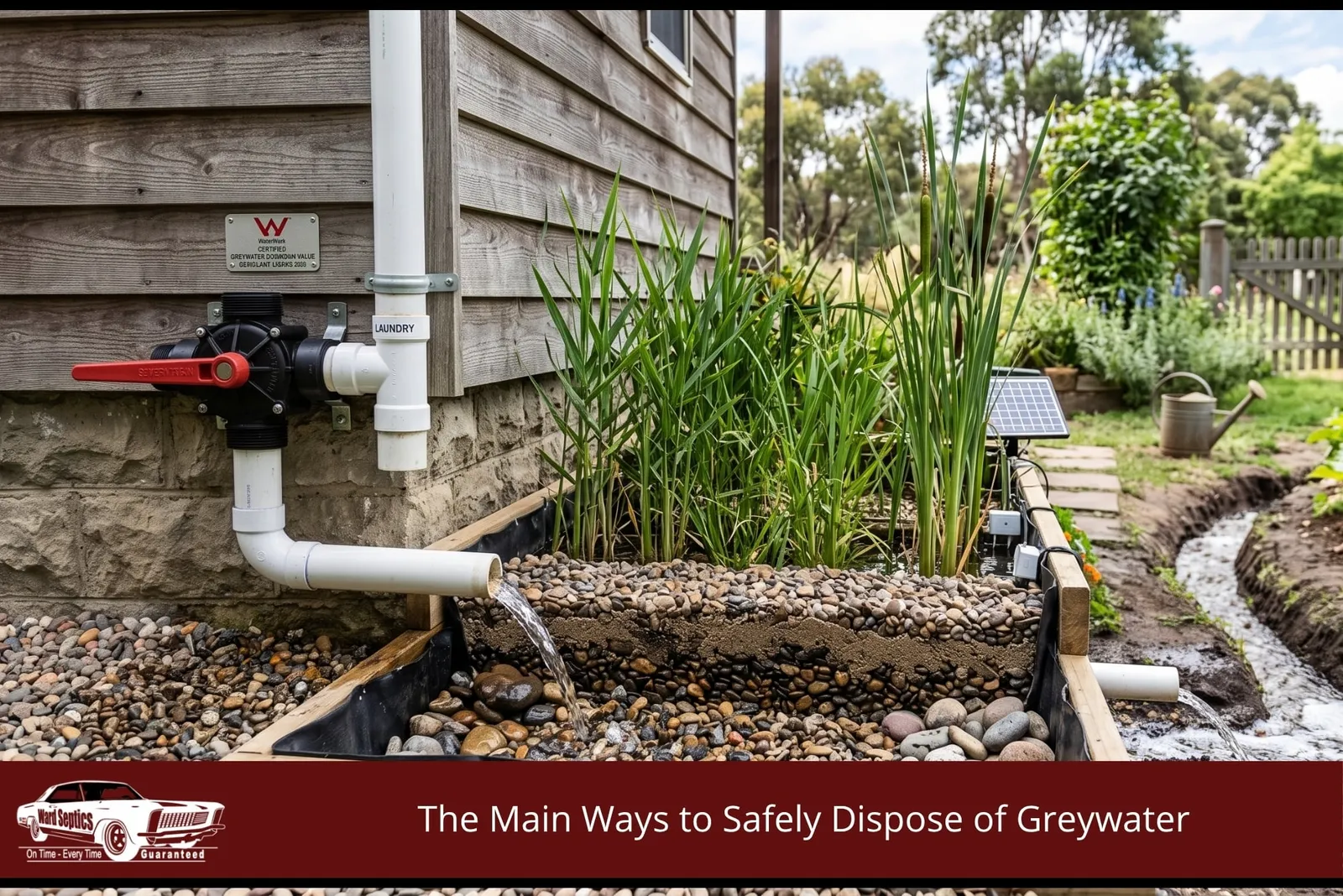
There is no single correct greywater solution for every rural property. The right approach depends on your soil type, the volume of greywater your household generates, your local council's requirements, and whether you want to simply dispose of greywater safely or actively reuse it to reduce your water consumption. Here are the main approaches used on rural Australian properties.
Immediate diversion for irrigation
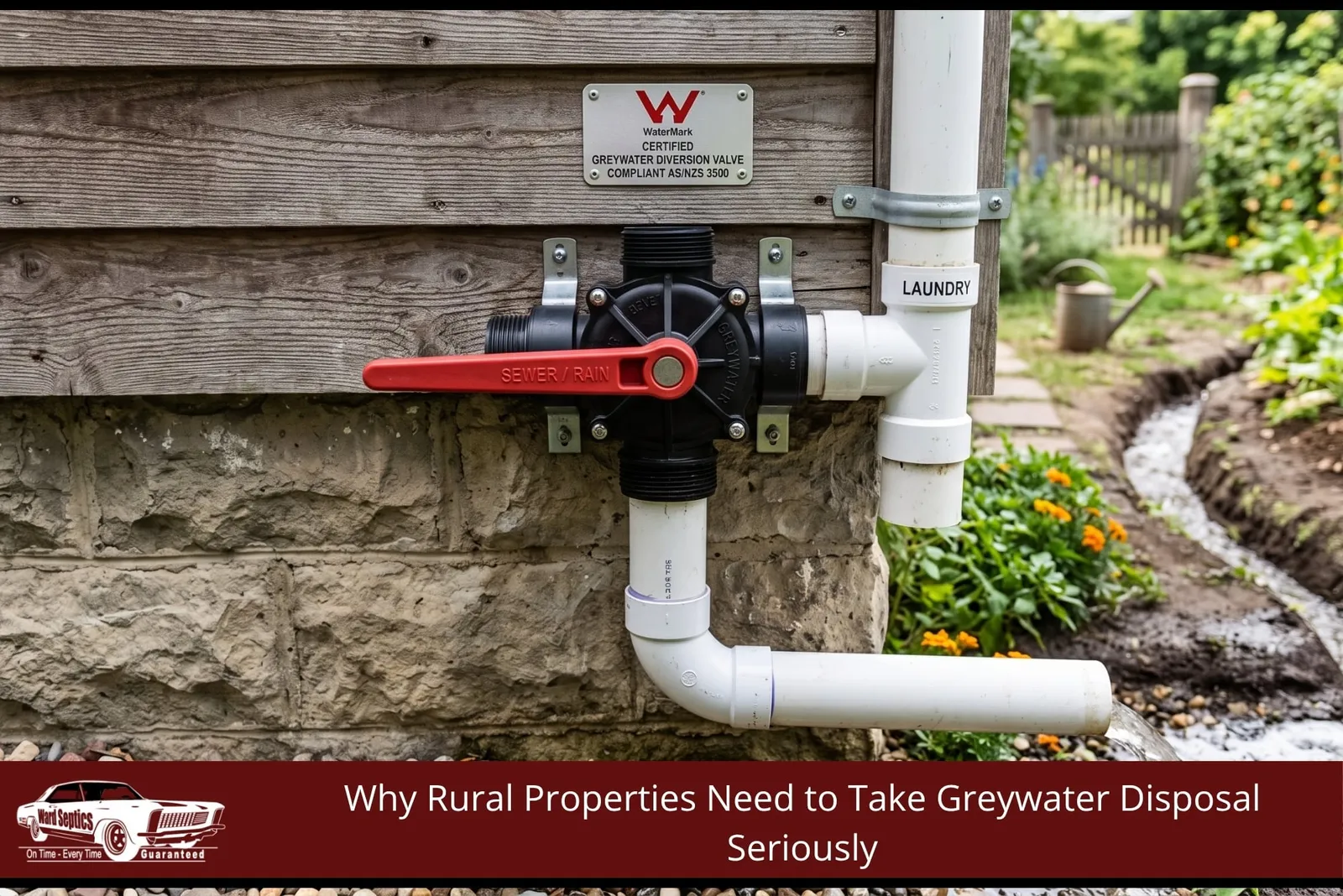
The simplest and most widely permitted approach is diverting greywater directly from the source, typically the laundry, shower, or bathroom basin, straight out to a garden bed or irrigation area without any storage. Because the water is used immediately rather than stored, the risk of bacterial growth and odour is significantly reduced, and most states allow this approach with comparatively light-touch regulation provided a coarse filter is used to remove lint, hair, and solids before the water reaches the soil. This method works well for laundry greywater, since washing machine outlets are easy to divert with a simple hose connection.
Certified greywater diversion devices
A step up from a simple hose diversion is a certified greywater diversion device, a manufactured unit that filters and redirects greywater from your bathroom and laundry fixtures to an irrigation area. These devices must carry product certification, and your council can only approve units that have been certified for this purpose. A diversion device is the right choice when you want a permanent, low-maintenance solution that handles greywater from multiple fixtures without manual bucketing or hose-swapping every time you do laundry.
Subsurface irrigation trenches
For properties with suitable soil and enough available land, a subsurface irrigation trench is one of the most effective long-term solutions. Greywater is distributed below the surface through perforated pipe, allowing the soil itself to filter and treat the water as it percolates downward, the same natural process your septic system's absorption trenches rely on. Subsurface trenches avoid surface ponding, reduce odour, and protect pets and wildlife from direct contact with the wastewater. They do require council approval and a site assessment to confirm your soil's absorption capacity is adequate for the volume of greywater your household produces.
Mulch basins
A mulch basin is a shallow pit filled with coarse organic mulch, positioned to receive greywater from a single source such as a laundry outlet. The mulch absorbs and filters the water as it percolates into the surrounding soil, and the organic material needs periodic replacement as it breaks down. Mulch basins are a simple, low-cost option well suited to smaller households or properties wanting to manage one or two greywater sources without a full irrigation system.
Greywater treatment and storage systems
If you want to store greywater for later reuse indoors, such as for toilet flushing or clothes washing, you need a proper treatment and disinfection system rather than simple diversion. Untreated greywater should never be stored for more than 24 hours, because that is the point at which pathogen levels begin to climb sharply. A treatment system filters and disinfects the water to a standard suitable for storage and indoor reuse, and these systems require accreditation in most Australian states before installation. Treated greywater can typically be reused for toilet flushing, which can save in the order of fifty litres of water per household per day, and for laundry use, which can save a further ninety litres per day, figures that matter considerably for a property relying on tank or bore water.
Combining greywater with your septic system
Many rural properties simply direct all their wastewater, greywater and blackwater together, into a conventional septic tank system, where it is treated as a single combined effluent stream before being dispersed to an absorption trench or other approved land application area. This is the most common and often the most practical approach, particularly for established properties where retrofitting a separate greywater diversion system would be costly or impractical. The trade-off is that combining greywater with blackwater increases the total volume your septic system and drainage field need to handle, which is an important consideration when sizing a new system or assessing whether an existing system has the capacity for additional fixtures or occupants.
If you are unsure whether your existing septic system has the capacity to handle your household's full wastewater load, or if you are considering separating greywater out to reduce pressure on your system, our septic tank inspection service can assess your system's current condition and capacity and advise on the best path forward.
The table below summarises the main disposal methods, who they suit, and what approval is typically required.
| Disposal Method | Best Suited For | Approval Needed? | Relative Cost |
|---|---|---|---|
| Subsurface irrigation trench | Properties with good soil absorption and adequate land area | Yes, council approval | Low to moderate |
| Mulch basin / mulch pit | Small households, single fixture diversion (e.g. laundry) | Often yes, varies by council | Low |
| Greywater diversion device | Showers, baths, basins, laundry, immediate use only | Yes, must be certified device | Low to moderate |
| Greywater treatment system | Households wanting to store and reuse greywater indoors | Yes, accreditation required | Moderate to high |
| Combined septic system | Properties already running a conventional septic system | Yes, as part of system approval | Included in system cost |
| Constructed reed bed / sand filter | Off-grid properties seeking natural filtration | Yes, site-specific design approval | Moderate |
Council Approval and Regulatory Requirements
Every Australian state regulates greywater disposal differently, and the specific requirements that apply to your property depend on your state, your local council, and in some cases your specific water authority. What is consistent across the country is that some form of approval is required for any permanent greywater diversion or treatment installation, even though manual bucketing or temporarily connecting a hose to a washing machine outlet for occasional use is generally exempt from approval in most jurisdictions.
In New South Wales, NSW Health and your local council regulate greywater reuse, with specific accreditation requirements for greywater treatment systems and installation approval required through your local authority regardless of whether you are using an accredited system. In Queensland, the Queensland Plumbing and Wastewater Code governs greywater facilities, with approval requirements based on the treatment plant's capacity and specific setback distances that must be maintained from buildings, boundaries, and water sources. South Australia and Victoria each have their own variations, generally requiring council approval for any installed diversion device or treatment plant, while exempting simple, temporary, manual diversion methods.
Across all states, there are some consistent siting restrictions worth understanding before you plan any greywater disposal area. Greywater systems should not be in areas with a shallow water table, highly porous soils such as pure sand, or any area showing visible signs of existing surface dampness such as seeps or springs, because these conditions increase the risk of greywater reaching groundwater without adequate filtration. Setback distances from your house, your property boundary, any dams or watercourses, and any bores or wells are also mandated and vary depending on your specific council and the type of system you are installing.
Before installing any greywater system, the right first step is a phone call or email to your local council's environmental health or building services team. They can tell you exactly what is required for your specific property, including whether a site and soil evaluation is needed, what setback distances apply, and whether your chosen system needs to be installed by a licensed plumber, which is the case in every state for anything beyond manual diversion.
| ALWAYS CHECK FIRST | Regulations and approval processes differ from state to state and even between neighbouring councils. Before purchasing or installing any greywater diversion device, treatment system, or irrigation trench, contact your local council directly to confirm the current requirements for your property. Installing an unapproved system can result in contravention notices and fines and may also create problems if you later sell the property and a building inspection identifies non-compliant wastewater infrastructure. |
|---|
Common Mistakes Rural Property Owners Make with Greywater
Most greywater problems on rural properties come from a small number of recurring mistakes. Avoiding these is often more important than choosing the most sophisticated system.
Letting greywater pool on the surface
If your irrigation area cannot absorb greywater as fast as it arrives, it will pool on the surface. This creates odour, attracts mosquitoes, and increases the risk of someone, particularly children or pets, coming into direct contact with wastewater that has not been treated. If you notice pooling, the irrigation area is undersized for your household's water use or your soil's absorption capacity is lower than assumed, and the system needs to be reassessed.
Including too many chemicals in greywater
Highly concentrated detergents, bleach, disinfectants, and antibacterial products do not just affect your septic tank's bacterial balance if your greywater eventually combines with blackwater. They also affect soil health and plant growth if your greywater is being used for garden irrigation. Switching to phosphate-free, biodegradable laundry and bathroom products significantly improves the long-term health of any soil receiving your greywater and reduces the nutrient load reaching the surrounding environment.
Storing greywater untreated
Storing untreated greywater for more than 24 hours, whether in a drum, tank, or any other vessel, allows bacteria to multiply rapidly and creates a genuine health risk. If your goal is to store greywater for later reuse, this requires a proper treatment and disinfection system, not simply collecting water in a container for use a few days later.
Ignoring kitchen and dishwasher water
Kitchen sink and dishwasher wastewater carries more grease, food residue, and chemical load than bathroom or laundry greywater, and many councils either restrict its inclusion in garden irrigation systems or exclude it from greywater entirely, directing it instead to the septic system. Treating all your wastewater sources identically without checking whether kitchen water needs separate handling is a common oversight.
Overloading the septic system's drainage field
If your household has grown, added bathrooms, or increased water use since your septic system was originally designed, the total volume of effluent, greywater and blackwater combined, reaching your drainage field may now exceed what it was designed to handle. Signs of an overloaded field include slow-draining fixtures, wet or boggy patches near the disposal area, and a persistent sewage smell around the yard. A periodic inspection is the most reliable way to catch this before it becomes a costly failure.
If you are noticing any of these warning signs, our septic tank pump-out and maintenance service can assess whether your system is keeping pace with your household's current wastewater volume.
| WARNING SIGNS TO WATCH FOR | Persistent odour around your irrigation area, unusually lush or discoloured patches of grass, standing water that does not drain away, or a noticeable increase in mosquitoes around the yard are all signs that your greywater disposal system is not keeping up with demand and should be assessed promptly. |
|---|
A Simple Checklist for Safe Greywater Disposal on Your Rural Property
Use the following checklist as a starting point when planning, installing, or reviewing a greywater disposal arrangement on your property.
- Contact your local council to confirm the specific approval and design requirements for greywater disposal in your area before purchasing any equipment.
- Have a site and soil assessment carried out if you are installing a new irrigation trench or mulch basin, to confirm your land can absorb the expected volume.
- Choose certified equipment only and confirm the manufacturer can provide a product certification certificate before your council will approve installation.
- Engage a licensed plumber for any permanent diversion, treatment, or irrigation installation, since this work falls outside what most states allow a homeowner to do themselves.
- Switch to biodegradable, phosphate-free cleaning and laundry products to protect both your soil and your septic system's bacterial balance.
- Never store untreated greywater for more than 24 hours and invest in a proper treatment and disinfection system if storage and indoor reuse is your goal.
- Keep kitchen and dishwasher wastewater separate from your garden irrigation system unless your council specifically confirms it can be included.
- Inspect your disposal area periodically for pooling, odour, or unusually lush growth, and address any issues before they become larger compliance or environmental problems.
- Have your overall on-site wastewater system, including the interaction between greywater disposal and your septic system, professionally reviewed every few years.
| FINAL THOUGHT | Safe greywater disposal on a rural property is a combination of the right system for your land, the right approval from your council, and consistent attention to how that system performs over time. Get those three things right and greywater becomes a manageable, even valuable, part of how your property uses water, rather than a source of ongoing problems. |
|---|
| NEED HELP MANAGING WASTEWATER ON YOUR RURAL PROPERTY? Septic Cleaning services rural properties across the region, offering everything from septic tank pump-outs and inspections through to advice on greywater systems that keep your property compliant and odour-free. Book a service or ask a question at septiccleaning.com.au/contact |
|---|